A Symbolic Heart of Washington, D.C. : The National Mall

sickofyourcrap.com – The National Mall, often referred to simply as “The Mall,” is a large, open park at the heart of Washington, D.C., the capital city of the United States. This iconic green space is more than just a recreational area; it is a symbol of American democracy, history, and culture. Stretching from the Capitol Building on the east to the Potomac River on the west, the Mall is flanked by numerous monuments and memorials, museums, and government buildings, making it a must-visit destination for anyone interested in the nation’s heritage.

Historical Significance

The National Mall has been the site of numerous historic events, including presidential inaugurations, protests, and celebrations. It was here that Martin Luther King Jr. delivered his famous “I Have a Dream” speech during the March on Washington for Jobs and Freedom in 1963. The Mall has also been the backdrop for countless concerts, festivals, and ceremonies, reflecting the diverse fabric of American society.

Monuments and Memorials

One of the most striking features of the National Mall is its collection of monuments and memorials, each dedicated to a pivotal figure or event in American history. The Lincoln Memorial, with its iconic view of the Reflecting Pool and the Washington Monument beyond, is a powerful symbol of emancipation and national unity. Nearby, the Martin Luther King Jr. Memorial pays tribute to the civil rights leader’s legacy. The Vietnam Veterans Memorial, a somber wall inscribed with the names of those who died in the Vietnam War, is a place of reflection and remembrance. Other notable memorials include the World War II Memorial, the Korean War Veterans Memorial, and the Franklin Delano Roosevelt Memorial.

Museums and Cultural Institutions

The National Mall is home to several of the Smithsonian Institution’s museums, which are free to the public and cover a wide range of subjects, from art and history to science and technology. The Smithsonian National Air and Space Museum, the National Museum of Natural History, and the National Museum of American History are among the most visited. These institutions not only preserve and exhibit artifacts and specimens but also serve as educational resources for visitors of all ages.

Recreational Opportunities

Despite its rich historical and cultural offerings, the National Mall also provides ample opportunities for relaxation and recreation. Its wide-open spaces are perfect for picnics, kite flying, and leisurely strolls. The Tidal Basin, located near the southern end of the Mall, is a popular spot for boating and for viewing the cherry blossoms in the spring. The annual National Cherry Blossom Festival is a celebration of the natural beauty and international friendship symbolized by the trees, a gift from Japan in 1912.

Conservation and Renewal

Over the years, the National Mall has faced challenges related to overuse, environmental degradation, and the need for infrastructure improvements. Efforts to restore and preserve the Mall have been ongoing, with projects aimed at improving accessibility, enhancing visitor experiences, and ensuring that this national treasure remains a vibrant and welcoming space for future generations.

In conclusion, the National Mall is more than just a park; it is a living museum that tells the story of the United States through its monuments, museums, and the events that have unfolded on its grounds. It is a place where history is honored, culture is celebrated, and the American spirit is embodied. Whether you’re a history buff, a nature lover, or simply seeking a peaceful place to enjoy the outdoors, the National Mall offers something for everyone.
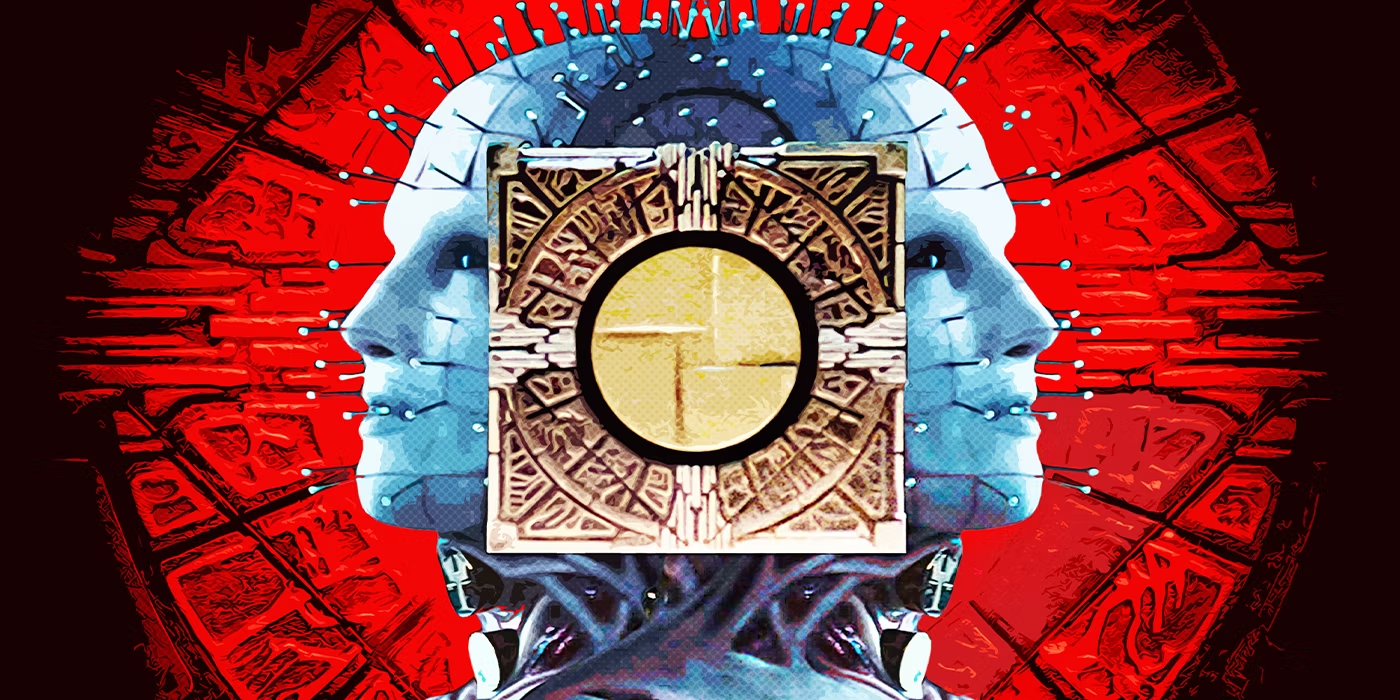
A Literary Exploration of Damnation: The Hellbound Heart

sickofyourcrap.com – Clive Barker’s seminal work, “The Hellbound Heart,” published in 1986, is a masterful exploration of the darker aspects of human desire and the consequences of succumbing to temptation. This novella, which later inspired the Hellraiser film series, delves deep into the themes of damnation, obsession, and the thin line between pleasure and pain. Through its intricate narrative and rich symbolism, Barker crafts a story that not only entertains but also invites readers to ponder the nature of evil and the human condition.

The Allure of the Lament Configuration

At the heart of “The Hellbound Heart” is the Lament Configuration, a puzzle box that serves as a gateway to the realm of the Cenobites, beings who exist to explore the extremes of human sensation. The box, with its promise of unimaginable pleasures, represents the temptation that lies at the core of the narrative. It symbolizes the forbidden fruit, an object of desire that, once pursued, leads to irreversible damnation. The characters’ interactions with the Lament Configuration serve as a metaphor for the human experience of wrestling with temptation and the consequences of giving in to it.

Characters and Their Descent

The novella’s characters, each driven by their own desires, embark on a journey that ultimately leads to their downfall. Frank, the protagonist, seeks to escape the mundanity of his life and the consequences of his actions, only to find himself ensnared in a far worse fate. His sister, Julia, is consumed by her own lusts, leading her to make a Faustian bargain with the Cenobites. Through these characters, Barker explores the idea that damnation is not just a supernatural event but a state of being that results from the corruption of the soul.

Themes of Pleasure and Pain

One of the most striking aspects of “The Hellbound Heart” is its exploration of the intertwined nature of pleasure and pain. The Cenobites, with their distorted bodies and insatiable appetites, embody this theme. They are neither wholly evil nor benevolent but rather exist in a state of perpetual exploration of the limits of sensation. This portrayal challenges traditional notions of good and evil, suggesting that they are not binary opposites but rather two sides of the same coin.

The Role of Desire in Damnation

Barker’s work suggests that it is not sin or transgression that leads to damnation but the insatiable nature of desire itself. The characters in “The Hellbound Heart” are not damned for their actions but for their inability to find satisfaction, for constantly seeking more, and for being unable to recognize the momentary nature of pleasure. This theme resonates with the reader on a deeply personal level, as it touches upon the universal human experience of longing and the emptiness that often accompanies fulfillment.

Conclusion

“The Hellbound Heart” is more than just a horror story; it is a profound meditation on the nature of desire, damnation, and the human condition. Through its rich symbolism and complex characters, Clive Barker invites readers to explore the darker aspects of their own souls. The novella serves as a cautionary tale, reminding us of the dangers of unchecked desire and the importance of recognizing the limits of our own appetites. In doing so, it stands as a testament to the power of literature to not only entertain but also to illuminate the depths of the human experience.

A Spirited Collection of Tales: The Haunted Library

sickofyourcrap.com – In the heart of a quaint, cobblestoned town, nestled between the whispering trees and the murmuring brook, lies a library unlike any other. This is not just a repository of knowledge, but a sanctuary for the curious, the dreamers, and those who dare to explore the realms beyond the tangible. Welcome to The Haunted Library, a spirited collection of tales that will tug at the edges of your imagination and send shivers down your spine.

The library, with its gothic architecture and ancient, ivy-covered walls, has been a fixture in the town for centuries. Its towering shelves are lined with books of every genre, from the classic to the contemporary, but it is the collection of tales known as “The Spirited Chronicles” that draws the most attention. These stories are not merely written; they are experienced, each page a portal to a world where the supernatural intertwines with the everyday.

The first tale, “Whispers in the Stacks,” tells of a young librarian who hears voices in the silence of the night. As she navigates the labyrinthine aisles, she discovers that the books themselves are speaking, their pages fluttering with untold stories, their bindings creaking with the weight of history. The librarian learns that the spirits of authors past roam the library, seeking a reader to bring their unfinished tales to life.

In “The Shadow of the Card Catalog,” a curious patron discovers an entry that should not exist. Drawn to the coordinates listed, he finds himself in a section of the library that is both familiar and utterly alien. The books here are alive, their covers breathing, their titles changing before his eyes. The patron realizes he has stumbled upon a realm where reality and fiction blur, and the only way out is to write his own escape.

“The Ghost of the Reading Room” is a tale of love lost and found. A spectral figure is seen every evening in the grand reading room, always at the same table, always with the same book. It is said that the ghost is a writer who penned a masterpiece that was never published, his spirit bound to the library until his story is told. Visitors have tried to read the book, but none have been able to finish it, the words fading as the clock strikes midnight.

“The Midnight Library” is a story of a bibliophile who discovers a secret door that only appears at the stroke of twelve. Beyond the door lies a library that defies time and space, where books from the future and the past coexist. The bibliophile learns that the library is a nexus of knowledge, a place where the fates of the world are written and can be rewritten. But with this knowledge comes a heavy responsibility, for every page turned can alter the course of history.

The Haunted Library is more than just a collection of tales; it is a journey into the unknown, a celebration of the written word, and a reminder that some stories are not meant to be contained within the pages of a book. They are meant to be lived, to be breathed, to be felt.

So, as the sun sets and the shadows lengthen, dare to step inside The Haunted Library. Let the musty scent of old paper and the soft glow of candlelight guide you. Open a book, any book, and let the spirits of storytellers past carry you away to a world where every ending is just another beginning, and every tale is a whisper of the infinite possibilities that lie within the realm of the imagination.

The Haunted Castles of Transylvania: Heart of Gothic Lore

sickofyourcrap.com – Nestled within the rugged, mist-shrouded landscapes of Romania lies the enigmatic region of Transylvania, a place steeped in history, folklore, and the allure of the supernatural. It is here, amidst the dense forests and towering mountains, that some of the world’s most haunted castles stand sentinel, guarding secrets and tales that have captivated imaginations for centuries. These fortresses, with their Gothic architecture and eerie atmospheres, are not just relics of the past but gateways to a world where the line between myth and reality blurs.

Bran Castle: The Home of Dracula

Perhaps the most famous of Transylvania’s haunted castles is Bran Castle, immortalized in Bram Stoker’s novel as the residence of Count Dracula. Perched on a high rock, its towers and turrets cut an imposing figure against the sky. While Stoker’s tale is fiction, the castle’s association with Vlad the Impaler, the inspiration for Dracula, adds a layer of historical intrigue. Visitors often report feeling an inexplicable chill as they explore its chambers, as if the shadows themselves whisper secrets of the past.

Corvin Castle: A Gothic Marvel

Another formidable structure is Corvin Castle, located in Hunedoara. This Gothic masterpiece, with its sprawling courtyards and imposing towers, was once the mightiest fortress in the region. It is said to be haunted by the spirit of its creator, Iancu de Hunedoara, and his son, the infamous Vlad the Impaler. The castle’s dungeons, where prisoners were once held in inhumane conditions, are believed to be the most haunted parts, with tales of ghostly apparitions and unexplained noises echoing through the halls.

Râșnov Fortress: Guarding Ancient Secrets

The Râșnov Fortress, situated on a rocky peak, has stood as a silent guardian over the region for centuries. Its thick walls and strategic location speak of a time when defense was paramount. Legends of hidden treasures and secret passages abound, and some believe the fortress is haunted by the spirits of those who once fought to protect it. The eerie silence that pervades the site, punctuated only by the wind whistling through the crenellations, adds to its mystique.

Peleș Castle: Opulence and Mystery

A stark contrast to its more sinister counterparts, Peleș Castle is a marvel of Neo-Renaissance architecture, nestled in the Carpathian Mountains. While not traditionally considered haunted, its luxurious chambers and secret passages have inspired their share of legends. The castle’s opulence, combined with its hidden rooms and the mystery surrounding its construction, creates an atmosphere of intrigue that captivates all who visit.

The Allure of the Unknown

The haunted castles of Transylvania are more than just historical sites; they are portals to a world where the veil between the living and the dead seems thinner. Each castle, with its unique history and legends, offers a glimpse into the soul of Transylvania, a region where the past is never truly past. Whether one believes in ghosts or not, there’s no denying the eerie allure of these Gothic fortresses, standing as silent witnesses to centuries of history, conflict, and the mysteries that lie beyond the grave.

As night falls and the fog rolls in, the castles of Transylvania seem to come alive, their silhouettes stark against the moonlit sky. It is in these moments that the stories of old seem not just possible, but probable, inviting the brave and the curious to explore the shadows and uncover the secrets that lie within.